
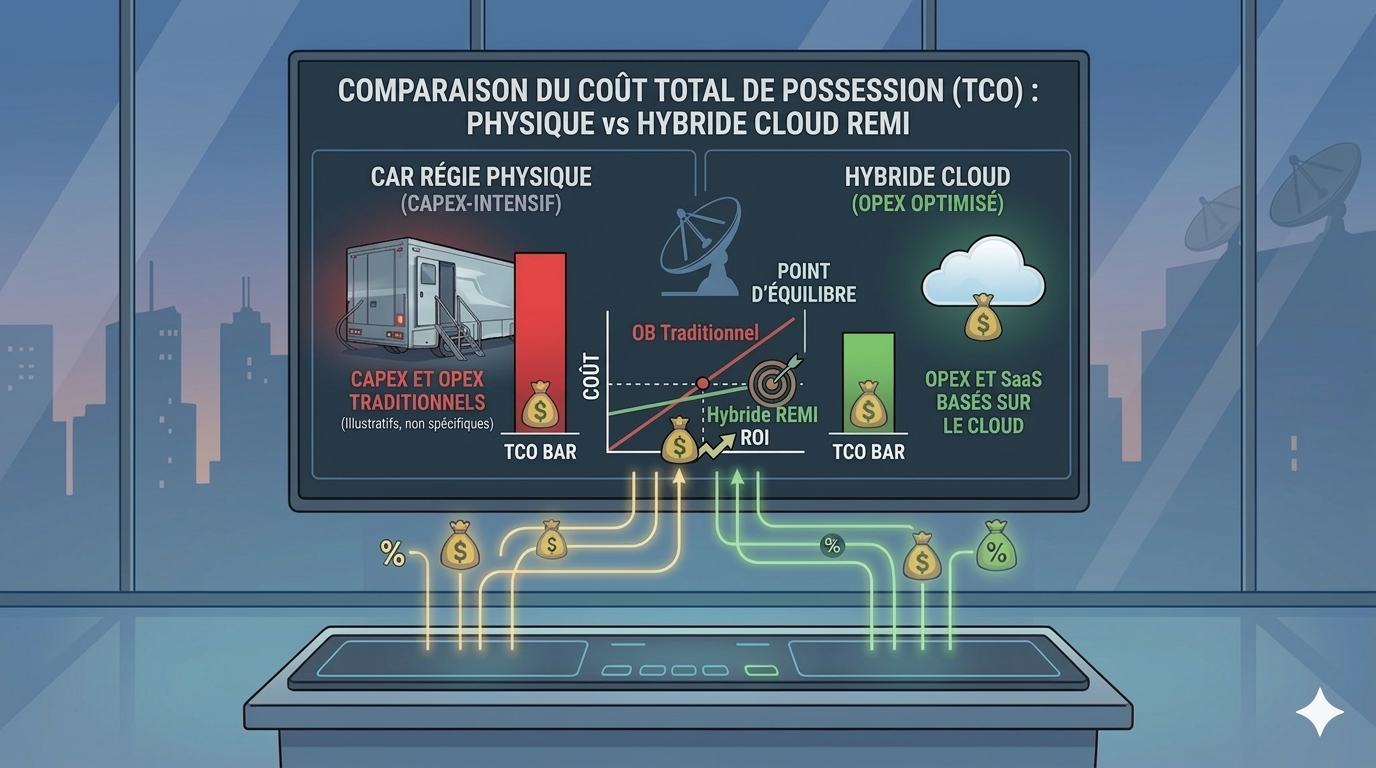
Before comparing, you need to understand what you are comparing. A complete physical production management system is a multi-dimensional investment whose total cost is systematically underestimated at the time of the initial decision.
1.1 — CAPEX: the initial investment
The following table details the typical CAPEX of an intermediate-sized professional broadcast production room, capable of managing multicam productions from 4 to 8 sources in 1080p with integrated graphics.

Point of Vigilance
These amounts do not include studio or field cameras, mobile OB buses, or contribution equipment. A complete OB engine car alone represents €500,000 to €3 million depending on its size. In the REMI framework, the control bus is replaced by field encoders — it is precisely this station that represents one of the most significant gains.
1.2 — Annual OPEX of a physical agency
CAPEX is only the tip of the iceberg. The annual OPEX for a physical management company includes positions that are often poorly anticipated:

REMI doesn't eliminate all costs — it eliminates them, processes them, or redistributes them. Understanding this transformation is essential to avoid unpleasant surprises.
2.1 — CAPEX field REMI
The field part remains a hardware investment, but considerably reduced compared to a traditional OB deployment:

2.2 — OPEX REMI: the three pricing models
This is where the models differ most strongly between suppliers. Three main pricing logics coexist on the market.
Model 1 — Monthly/annual SaaS subscription
This is the dominant model of cloud-native platforms (BenaNative, Singular.Live, PTZOptics Hive). Access to the cloud delivery platform is billed by capacity — number of simultaneous sources, number of destinations, broadcast volume — regardless of the number of hours of actual use.
Model 2 — Pay-per-use billing
Platforms like TVU Producer offer a consumer model: you buy credits or tokens that are debited at the time of active production. This model is particularly suitable for event producers with occasional peaks of activity.
Model 3 — Perpetual license + dedicated cloud infrastructure
Broadcast-grade solutions like Grass Valley AMPP, Ross Ultrix, or Zixi offer a hybrid model: a software license (perpetual or annual) and a dedicated cloud infrastructure billed for the reserved GPU/CPU capacity. This model is aimed at major broadcasters who need guaranteed 24/7 availability and broadcast SLAs.
The TCO (Total Cost of Ownership) over 3 years is the most honest metric to compare the two approaches. The example below is calibrated to an organization producing 80 events per year of 4 hours on average, with 4 simultaneous camera sources.

Calculation hypotheses
80 events/year × 4 hours × 3 years = 960 hours of production. Payroll calculated on broadcast engineer profiles (50—70,000 euros gross). Travel calculated for 60% of events requiring a field presence. The SRT bandwidth is estimated on 4 sources at 15 Mbps each on a dedicated link. These figures are an order of magnitude: each real situation must be the subject of a specific calculation.
The key question is not “is REMI cheaper?” But “at what volume is REMI cheaper in my context?” ”. The break-even point depends on three variables: the initial CAPEX, the unit cost per hour, and the frequency of use.
4.1 — Analysis by production volume

This analysis reveals a counterintuitive phenomenon: beyond a certain volume, physical control becomes competitive again because its significant fixed cost is amortized over a large number of productions. Cloud native REMI, on the other hand, has a variable cost that does not decrease with volume (or even increases in SaaS if you subscribe to higher capacities).
4.2 — Hidden variables that switch the equation
Several factors change the analysis significantly and must be taken into account in each specific situation:
Financial Analysis Alone Does Not Capture All the Benefits of REMI Several qualitative dimensions influence the real return on investment.

6. Decision framework: which architecture for which context?
Before making a decision, any organization should answer these seven questions. The answers naturally draw up the most suitable architecture.

REMI offers a clear and documented economic advantage for organizations producing between 20 and 150 events per year, with a geographic dispersion of events and quality requirements compatible with current cloud solutions. In this segment, savings of 40 to 70% on 3-year TCO are achievable.
On the other hand, for large TV broadcasters with high frequency productions and strict broadcast requirements (genlock, multi-track audio, sub-200ms latency), hybrid REMI with remote hardware infrastructure remains the only technically viable and technically viable option. And for organizations with fewer than 20 events/year, the occasional rental of an external management agency or service provider is often more economical than any dedicated infrastructure.
The optimal decision is not binary. Most organizations are evolving: they start with a cloud-native model for secondary productions, validate workflows and competencies, and then evolve their architecture to a hybrid model as their volume and requirements increase.
Practical Next Step
Before making an architectural decision, calculate your number of hours of active production over 12 months and estimate the geographic dispersion rate of your events. These two figures alone already guide 80% of the decision. The rest comes down to signal quality analysis — the subject of article 3 of this series.


